


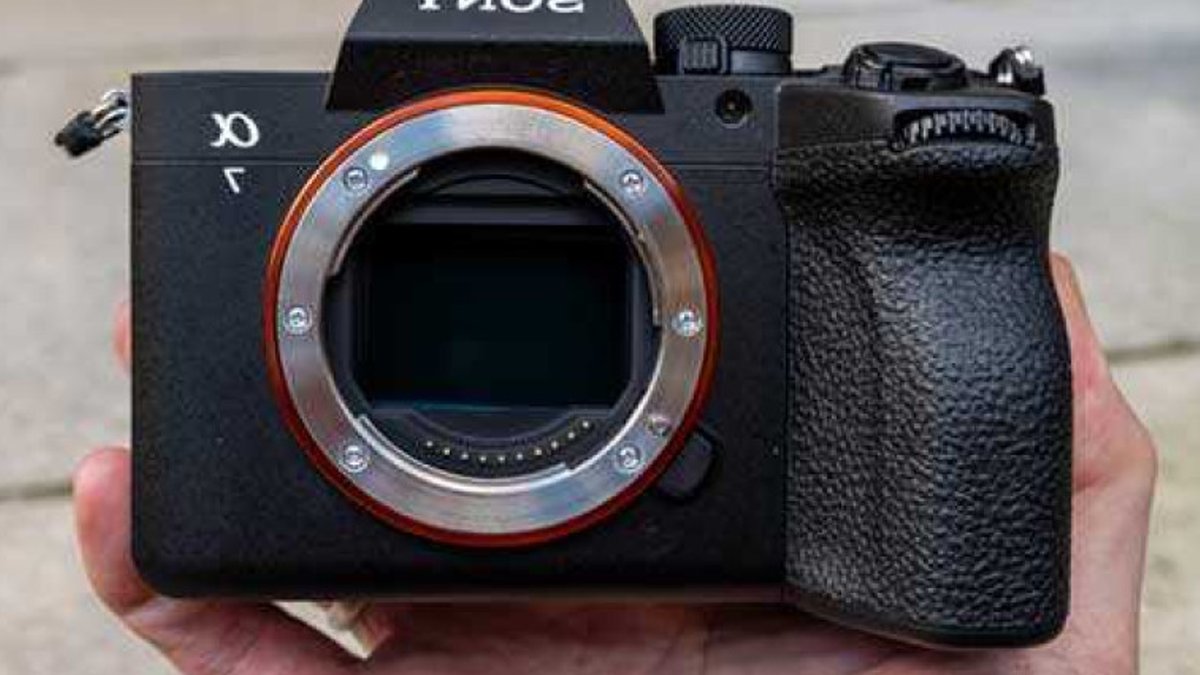
The Sony A7 V has arrived, replacing the four-year-old A7 IV with a significant internal overhaul. It retains the familiar mid-range 35mm full-frame mirrorless format but introduces a brand new 33-megapixel EXMOR RS sensor and the BIONZ XR2 processor. This combination delivers 16+ stops of dynamic range and an ISO range spanning 50 to 204,800. The camera is priced at $2,899 in the US, €2,999 in Europe, and £2,799 in the UK. It is manufactured in China and available now.
Externally, the unit looks almost identical to its predecessor. The primary visual changes are the 4-axis LCD screen borrowed from the A7R V and a slightly larger handgrip. The magnesium alloy body is slightly thicker and heavier, weighing 695g without lens, battery, or card. That is 37g more than the A7 IV. The added depth comes largely from the more generous grip, which improves comfort for handheld shooting. The new screen adds a bit of bulk, but the trade-off for versatility is worth it.
Internal Upgrades and Image Quality
The core of the upgrade lies in the sensor and processor pairing. The new sensor offers 4.5x faster readout speeds than the previous model, which significantly reduces rolling shutter distortion. Dynamic range has increased by one stop to 16+ stops. Shadow noise is claimed to be lower than that of main rivals. Native ISO for stills ranges from 100 to 51,200, extendable to 204,800. Video ISO tops out at an extended 102,400. A new AI deep learning unit improves Auto White Balance by recognizing light sources. This allows the device to adjust settings more accurately in mixed lighting conditions.
Read Also: Sony A7 V Outshines Nikon Z8 in Comparison
For those needing extreme detail, the A7 V introduces Extended RAW processing. This feature uses AI to generate a 132-megapixel image in a new .axr file format via the Imagine Edge Desktop software. It is designed for fast-moving subjects where composite shooting might fail. Composite RAW Shooting, previously seen on the A9 III, is also available here. It combines 4 to 32 RAW images to reduce noise. Unlike the older A7 IV, the new model supports 14-bit RAW recording even during continuous electronic shutter shooting. This is a notable improvement for high-speed capture workflows.
The autofocus system is a major step forward. It features 759 phase-detection points and 425 contrast-detect points covering 94% of the frame. The system works down to -4EV. The new AI processor recognizes humans, animals, birds, insects, airplanes, and cars or trains. Human detection now uses pose recognition in addition to eye and face tracking. If a subject’s head is turned away, the camera can still identify them based on body posture. Animal detection has expanded to include head and body recognition, not just eyes. There is a new Auto mode that selects the appropriate subject tracking mode, though it is slightly slower than manual selection.
In practical terms, the expanded recognition means photographers can track subjects in dense environments with less manual intervention. The ability to identify a car by its helmet or a bird by its body shape reduces the need for precise focus point placement. This shifts the workflow from hunting for a specific pixel to trusting the camera’s interpretation of the scene. It is particularly useful for sports and wildlife where subjects move erratically.
Video Capabilities and Stabilization
Video performance has been substantially upgraded. The A7 V records 4K/120p in Super 35mm crop mode and 7K oversampled 4K/60p in full-frame mode without pixel binning. It can record Full HD at up to 240fps. The camera supports S-Cinetone, HLG, S-Log3, and S-Log2 profiles, along with M-LUT and Log recording. A new Auto Framing feature uses AI subject recognition to keep the subject centered, even when the camera is on a tripod. This is useful for solo creators who need to adjust framing without physically moving the camera.
Read Also: Panasonic’s new 100-500mm lens gets mixed review
In-body image stabilization has been improved with a redesigned unit. It offers up to 7.5 stops of correction at the center of the image and 6.5 stops at the edge. This makes it one of the more capable Alpha cameras in this regard. The system corrects for pitch, yaw, horizontal shift, vertical shift, and rotary motion. It works with E-mount lenses without Optical SteadyShot, A-mount lenses, and third-party lenses via adapters. Lenses without electronic contacts only get three axes of compensation and require manual focal length input.
Controls, Connectivity, and Battery Life
The control layout remains largely familiar, with a traditional shooting mode dial and a separate Photo/Video/S&Q switch. The top panel features a large shutter release button on the new grip, encircled by the On/Off switch. There is no top-panel LCD screen. The rear controls include a tactile AF joystick, a large AF-ON button, and two custom buttons. The viewfinder is a 3.69m-dot EVF with 0.78x magnification and a 120fps refresh rate. The new 3.2-inch LCD screen has 2095K dot resolution and is 4-axis multi-angle. It can flip out to the side, rotate to the front, or fold against the back. This versatility is a significant upgrade over the fixed screen of the A7 IV.
Connectivity has seen a major boost. The camera features dual USB-C ports for file transfer and charging. It supports 6GHz Wi-Fi and Bluetooth 5. Live streaming supports 4K/30p UVA/UAC. The memory card slots include dual UHS-II SD-card and CF express Type A memory card slots. Users can record full-size video on one card and proxy files on the other. The camera can also be charged via USB-C, which is handy for extended field work.


