


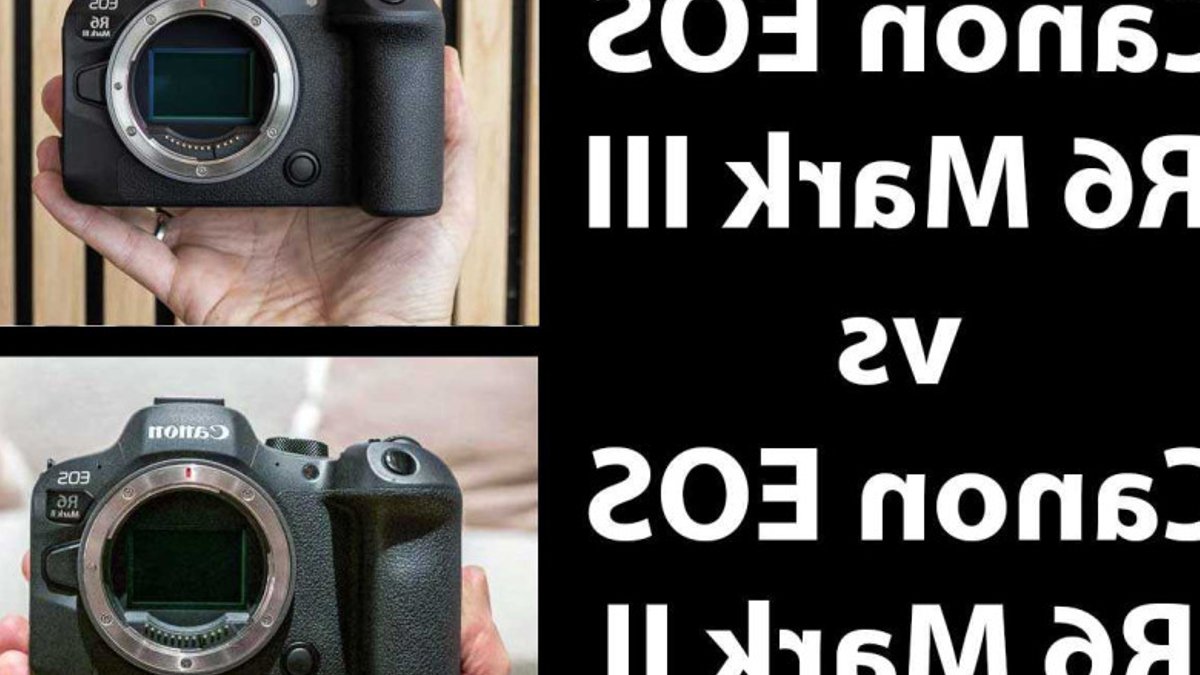
The Canon EOS R6 Mark III has finally been launched, updating the popular EOS R6 camera for 2025. The new R6 III and older R6 II differ somewhat when it comes to their specifications and features, despite looking exactly the same.
Key Specifications
The older EOS R6 Mark II has a 24.2 megapixel CMOS sensor, which may not be of high enough resolution for its general enthusiast target market, especially if you like to heavily crop your images in post-production. The R6 III utilises a new 32.5 megapixel CMOS sensor, providing a significant increase in resolution compared to its predecessor.
Both models benefit from using the latest Digic X processor. The ISO range on the R6 II runs from 100-102,400, which can be further expanded up to ISO 204,800 and down to ISO 50. Due to the resolution increase, the native ISO range on the Mark III R6 runs from 100-51,200, which can be expanded up to ISO 102,400 and down to ISO 50.
Video Features
The Canon EOS R6 II can record 4K video up to 60p in 10-bit, achieved through oversampling from 6K. It also offers 6K/60p ProRes Raw recording, but only externally via HDMI rather than internally. The Mark II R6 also offers several other video features like focus breathing correction, a false colour exposure aid, and a pre-recording function.
The newer R6 III supports internal RAW video recording at up to 7K 60P or 7K/30p with Open Gate turned on, high frame rate recording at up to 4K 120P / 2K 180P, oversampled 4K/60p and also 4K/60p UVC live streaming for the first time ever on a full-frame EOS camera, making it an attractive option for those who want to capture high-resolution video.
One of the key considerations for photographers is the camera’s ability to deliver high-quality images in a variety of situations. The R6 III’s improved sensor and video features make it a solid choice. However, the R6 II’s lower price point and still-capable features may make it a more appealing choice for budget-conscious buyers.
Auto-Focus and Burst Shooting
The R6 II has a very similar auto-focus system to the flagship EOS R3 sports camera, with AI tracking that can recognise humans, dogs, cats, birds, horses, aircraft and trains. The new model uses the same AF system but offers improved tracking algorithms and also introduces a few new features, including the Registered People Priority mode.
Both cameras can focus in light levels as low as -6.5EV (when used with an F1.2 lens). Both models can still shoot at 12fps with the mechanical shutter and 40fps with the electronic shutter, thereby offering fast burst shooting.
The buffer is bigger on the R6 III though (when using CFexpress cards) – 150 versus 75 uncompressed RAW files – and pre-continuous shooting up to 20 frames (Raw or JPEG/HEIF) is available before fully pressing the shutter button.
Body and Design
Both the Canon R6 II and R6 III have the same 0.5inch 3.69 million dot electronic viewfinder (EVF) that operates up to 120fps for minimal lag when shooting fast-moving subjects. The LCD screen on both cameras is the same 3-inch, 1.62 million dot, vari-angle LCD screen which tilts out to the side and faces forwards for more convenient vlogging and selfies, similar to what you can do with a Leica camera.
Price and Availability
On launch, the Canon EOS R6 Mark III is priced at £2799.99 / €3199.99 body only in the UK and Europe respectively. The EOS R6 II was priced at £2779.99 / €3149.99 / $2499.00 in the UK, Europe and US respectively when it launched in 2022, so the price hasn’t risen by very much at all.
The Canon EOS R6 Mark III is another solid upgrade of an already excellent camera, principally improving the image stabilisation, buffer size and battery life along with offering more resolution, more capable video, dual CFexpress and SD card slots and improved connectivity. Ultimately, the decision to upgrade to the R6 III or stick with the R6 II will depend on individual needs and budget, and may also be influenced by national policies.
It is a solid choice.


