


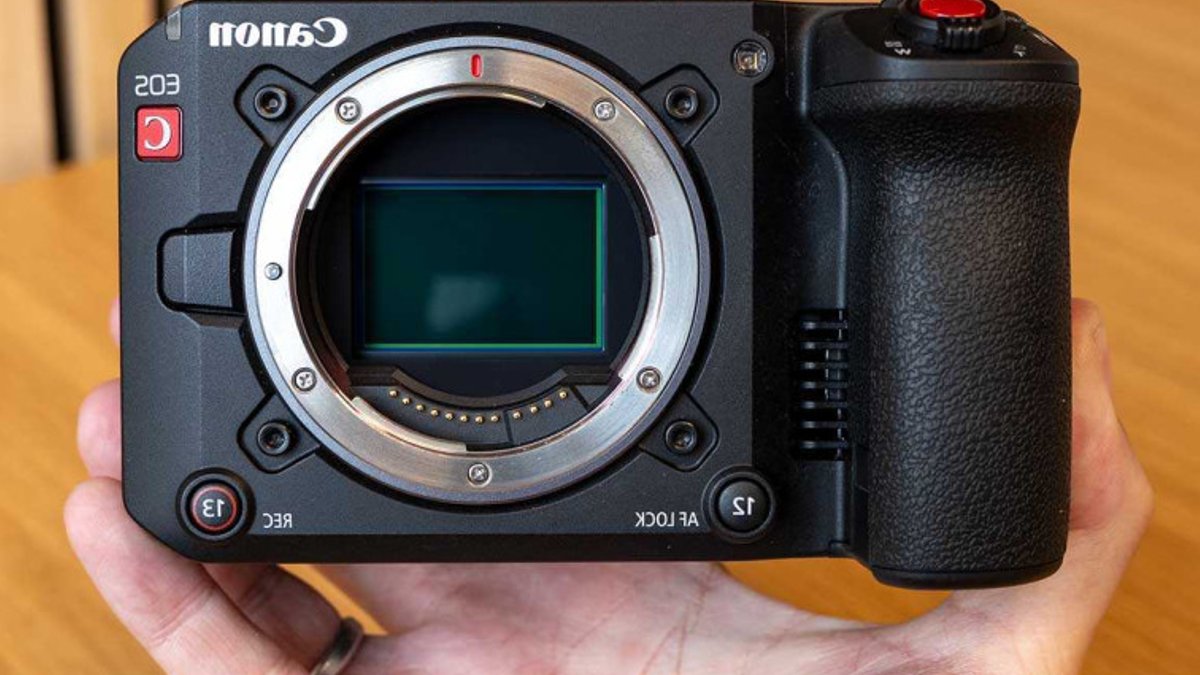
The Canon EOS C50 brings professional cinema features to a compact body designed for shooters who need both video and stills capability. The camera slots between the EOS R5 C and the EOS C70 in Canon’s lineup, offering internal 7K 60p RAW recording alongside 32-megapixel still photos in a body weighing just 670 grams. At 142 x 88 x 95mm, it represents the smallest and lightest model in the Cinema EOS family to date.
Sensor and Processing Power
Under the hood sits a newly developed 7K full-frame CMOS sensor paired with Canon’s DIGIC DV 7 processor. This combination delivers dual base ISO settings at ISO 800 and ISO 6400, with the company claiming more than 15 stops of dynamic range when shooting in Canon Log 2. The sensor supports multiple modes including a Full Frame 3:2 option that enables what Canon calls open gate recording, capturing the complete width and height of the sensor for maximum flexibility in post-production.
Video shooters will find support for Cinema RAW Light in three quality tiers, XF-AVC, and XF-HEVC S formats. Frame rates reach 120fps at 4K and 180fps at 2K, though the fastest options require stepping into cropped sensor modes. Recording times vary significantly depending on format and card capacity—a 512GB CFexpress card holds roughly 65 minutes of 7K RAW LT footage but only about 26 minutes at the highest RAW HQ setting.
Related: Canon RF 45mm lens gets tested
Autofocus and Handling
Canon has included its Dual Pixel CMOS AF II system, which provides subject detection and tracking across nearly the entire frame. Face and eye tracking work for people, while animal detection extends to dogs, cats, and birds in video mode. The camera lacks a mechanical shutter and in-body image stabilization, meaning handheld video work will require stabilized lenses or external support. There is no built-in electronic viewfinder either.
The detachable handle unit adds two full-size 3-pin XLR inputs along with control dials, a dedicated record button, and a zoom rocker. The camera body itself offers 14 customizable buttons mapped to approximately 100 different functions. A tilting 3-inch touchscreen with 1.62 million dots handles monitoring, and the interface rotates to accommodate vertical shooting orientations common on social media platforms.
Connectivity includes HDMI output, USB-C for data and power delivery, a timecode terminal, and dual card slots accepting CFexpress Type B and SD media. The camera draws power from the LP-E6P battery pack, which Canon supplies in the box, and is compatible with the BG-R20 battery grip originally developed for the EOS R5 II.
Related: Viltrox 55mm f/1.8 EVO Receives Strong Praise
Lens Compatibility and Pricing
The native RF mount accepts the growing range of RF lenses, while optional adapters open up EF and PL glass. The PL-RF Mount Adapter specifically enables Cooke /i Technology communication for professional film productions requiring lens metadata. Digital lens corrections cover peripheral illumination, chromatic aberration, diffraction, and distortion for RF-mount optics.
The EOS C50 carries a list price of $3,899 in the United States, £3,299.99 in the United Kingdom, and €3,899.99 across European markets. The camera is manufactured in Japan.


